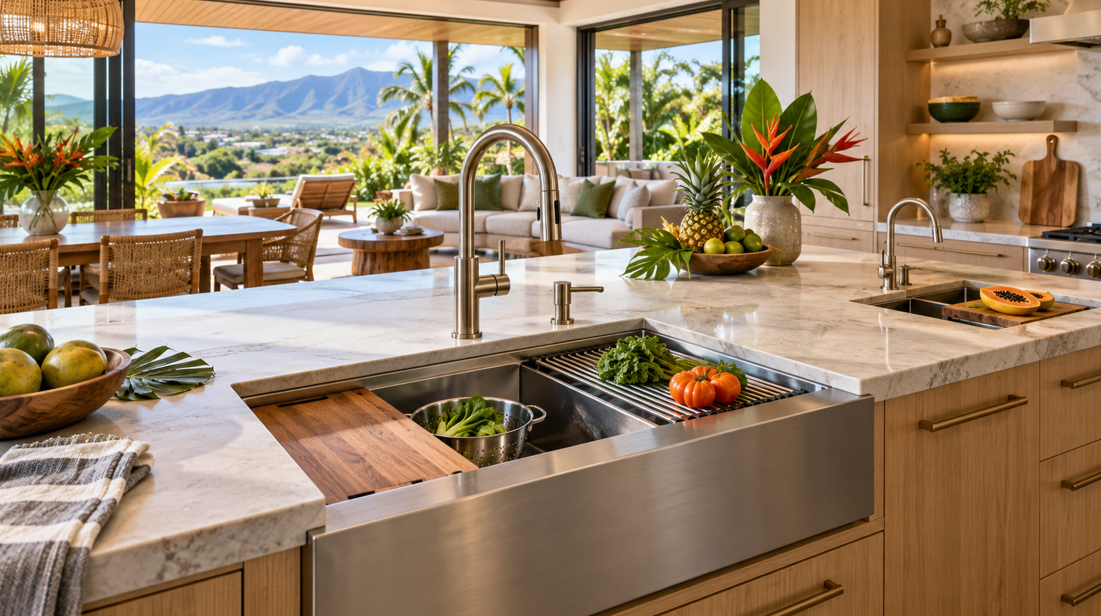
A kitchen sink may be one of the most frequently used features in a home, but it is no longer being treated as a purely practical afterthought.
In 2026, homeowners are increasingly looking at the sink as part of the entire kitchen design. Size, bowl configuration, installation style, accessories, countertop integration, and even how the sink supports food preparation can influence the decision.
That shift makes sense for Mililani households. Kitchens often need to accommodate busy family routines, home cooking, entertaining, and the realities of Hawaii’s warm, humid climate. A sink that looks good but makes everyday tasks harder is unlikely to feel like a successful upgrade.
Broader 2026 kitchen-industry research points towards kitchens becoming more multifunctional, personalised and visually seamless, while workstation sinks have continued to attract attention for bringing preparation and clean-up functions together in one area.
For homeowners planning a renovation, Selective Stone offers an opportunity to consider the sink alongside countertops, fixtures, and other kitchen materials rather than treating each decision separately.
So, which sink trends are worth paying attention to in 2026? Here are the ideas that make the most practical sense for Mililani homes.
1. Larger Single-Bowl Sinks Keep Kitchens Simple
One of the most practical directions in modern kitchen design is the large single-bowl sink.
For years, double-bowl sinks were considered the standard choice in many kitchens. Dividing the sink into two compartments made it possible to separate washing and rinsing tasks.
That arrangement still works well for some households, but modern dishwashing habits have changed the way many homeowners use their sinks.
When a dishwasher handles most plates, glasses, and cutlery, the sink is often used for larger jobs: washing pots, rinsing baking trays, preparing vegetables, cleaning oversized cookware, and filling large containers.
A spacious single bowl gives these items more room.
There is no divider in the centre competing for space, which can make it easier to manoeuvre a stockpot, roasting pan, or large chopping board.
For a family kitchen in Mililani, that flexibility can be useful.
The trade-off is that a single-bowl design does not naturally separate tasks. Homeowners who frequently hand-wash dishes while using another section for food preparation may still prefer a divided sink.
The trend is therefore less about declaring one configuration superior and more about choosing the bowl layout around the way the household actually works.
2. Workstation Sinks Turn One Area Into Several
One of the clearest sink trends of 2026 is the continued evolution of the workstation sink.
These sinks incorporate ledges or tracks that support accessories such as chopping boards, colanders, drying racks, trays, and other preparation tools. Instead of every task occupying a separate section of countertop, several jobs can happen directly over the sink.
Industry coverage from the 2026 Kitchen & Bath Industry Show highlighted workstation sinks becoming larger, more refined and more adaptable, with accessories designed to support preparation, rinsing, drying and serving.
For Mililani homeowners, the appeal is easy to understand.
More Usable Preparation Space
A chopping board fitted over the sink can temporarily extend the working surface.
That can be particularly useful in kitchens where counter space is limited.
Easier Food Preparation
Vegetables can be rinsed in a colander, moved onto the preparation board, and trimmed without carrying dripping ingredients across the kitchen.
Better Drying Options
An integrated roll-up or fitted drying rack allows glasses, produce, or dishes to drain directly into the basin.
Less Countertop Clutter
Accessories can help keep preparation tasks concentrated around one work zone rather than spreading bowls, chopping boards, and racks around the kitchen.
For households that cook frequently, this may be one of the most practical sink developments to consider in 2026.
3. Stainless Steel Remains a Practical Hawaii Choice
New trends do not always mean abandoning proven materials.
Stainless steel continues to make sense in kitchens because it combines a clean appearance with practical everyday performance.
That is particularly relevant in Hawaii.
A kitchen sink deals constantly with water, food residue, cleaning, utensils, pots, and temperature changes. Stainless steel is widely used for these environments because it is durable, relatively easy to maintain, and works with many kitchen styles.
It can suit a modern white kitchen, a warm natural-wood design, an industrial-inspired space, or a transitional remodel.
For Mililani homes, stainless steel also works well visually with many common appliance and fixture finishes.
However, homeowners should remember that stainless steel is corrosion-resistant rather than completely corrosion-proof.
Hawaii’s environment can expose household materials to humidity and, depending on location and airflow, salt-containing coastal air. Regular cleaning remains important, particularly when salts, harsh chemicals, or other residues accumulate on metal surfaces.
Avoid leaving strongly corrosive cleaning products in the basin and follow the manufacturer’s cleaning instructions for the particular sink.
With appropriate care, stainless steel remains one of the most versatile sink materials available.
4. Undermount Sinks Support Cleaner Visual Lines
Another important direction is the preference for cleaner, less visually complicated kitchens.
The National Kitchen & Bath Association’s 2026 trends research identifies seamless design and minimal detailing among the broader themes shaping kitchen interiors.
Undermount sinks fit naturally into that approach.
Instead of resting on top of the countertop with a visible rim, an undermount sink is attached beneath the work surface.
This creates a continuous countertop edge around the opening.
Visually, the result can feel cleaner and more integrated.
There is also a practical advantage: crumbs and small amounts of water can be wiped from the countertop directly into the sink without encountering an exposed sink lip.
That makes undermount sinks particularly attractive with stone and engineered countertop surfaces.
For Mililani homeowners planning both a new sink and a new countertop, choosing the two together is important. Sink dimensions, cabinet width, cut-out design, faucet placement, and countertop fabrication all need to work as a system.
5. The Sink Is Becoming Part of the Kitchen Island
Kitchen islands continue to serve several purposes at once.
They can provide food preparation space, seating, storage, serving areas, and gathering points. In larger kitchens, the island may become the centre of daily household activity.
Adding the main sink or a preparation sink can make the island even more functional.
A sink-equipped island allows homeowners to prepare food while facing into the kitchen or adjoining living area rather than standing with their back to the room.
That can be appealing in homes where cooking and socialising happen together.
For families, an island sink can also create a convenient central clean-up zone.
But it requires thoughtful planning.
Plumbing needs to be considered early. The island must have enough depth for the sink, faucet, and surrounding workspace. Dishwasher placement should make sense. Seating should be positioned so that dirty dishes do not dominate the dining side of the island.
The sink should improve the island rather than overwhelm it.
6. Sink Accessories Are Becoming More Useful
Accessories are no longer limited to a basic drain rack.
One reason workstation sinks have gained attention is the variety of tools designed to fit directly into the sink.
Depending on the model, these can include:
Fitted chopping boards
Colanders
Drying racks
Drain baskets
Bottom grids
Serving trays
Strainers
The benefit is efficiency.
Rather than purchasing several unrelated accessories and trying to store them around the kitchen, homeowners can choose a coordinated sink system designed for multiple tasks.
This can be particularly useful in busy kitchens where organisation is a priority.
However, more accessories are not automatically better.
Ask which features you will genuinely use.
A household that prepares fresh produce daily may get excellent value from a fitted colander and chopping board. Another homeowner may prefer a simpler sink with maximum open bowl space.
The best sink is not necessarily the one with the longest feature list. It is the one whose features match your routine.
7. Deep Bowls Continue to Appeal to Serious Home Cooks
Bowl depth is another consideration that can significantly affect daily use.
A deeper sink provides more room for large pots and can help contain splashing.
For homeowners who cook regularly, this can be valuable.
Large cookware, rice pots, mixing bowls, baking dishes, and serving pieces can be easier to clean when the basin provides sufficient depth.
There is a comfort consideration, however.
An extremely deep sink may require some users to bend further when reaching the bottom. Countertop height, user height, sink mounting style, and bowl depth all interact.
This is why looking at sink dimensions in person can be more useful than choosing from a photograph alone.
A difference of a few inches can change how a sink feels in daily use.
Homeowners comparing sizes, configurations and materials can explore available sinks while thinking about how the basin will work with their cabinetry and countertop selection.
8. Clean Shapes Are Winning Over Excessive Detail
2026 kitchen design is placing significant emphasis on visually cohesive spaces rather than unnecessary ornamentation.
For sinks, that can translate into straightforward geometry and clean edges.
Rectangular basins with gently rounded internal corners are particularly practical because they can create a contemporary appearance while remaining easier to clean than extremely sharp corners.
The goal is balance.
Very rounded sinks may not deliver the architectural look some homeowners want. Extremely tight square corners can collect food residue and require more attention during cleaning.
A softened modern shape gives homeowners a way to achieve both design clarity and practical maintenance.
This works particularly well in Mililani kitchens built around light countertops, natural wood cabinetry, and restrained hardware.
9. Homeowners Are Thinking About the Faucet and Sink Together
A sink and faucet function as a pair.
Choosing one without considering the other can create problems.
A faucet that is too tall or powerful for a shallow basin may increase splashing. A faucet with insufficient reach may not serve a wide sink comfortably. A large workstation sink may benefit from a pull-down spray head that can reach different parts of the basin.
Finish matters too.
Stainless steel sinks pair naturally with many faucet finishes, but homeowners are not limited to perfect matching.
Brushed, darker, warmer, or contrasting fixtures can help establish the overall kitchen style.
What matters most is coordination.
Consider faucet height, reach, handle clearance, spray functions, mounting position, and the space available behind the sink before making the final decision.
This becomes particularly important when the sink is installed on an island, where the faucet will be visible from several directions.
10. Easy Maintenance Is Becoming Part of Good Design
A beautiful kitchen should not require unnecessary effort to keep looking good.
That is why practical maintenance deserves to be considered a design feature.
For Mililani families, the kitchen may be active throughout the day. Breakfast preparation can quickly turn into school lunches, dinner cooking, and evening clean-up.
A sink that is difficult to wipe down or has awkward corners can become frustrating.
When comparing options, ask:
How easily can the bowl be cleaned?
Are the corners accessible?
Does the finish show water marks easily?
Is there a bottom grid, and can it be removed easily for cleaning?
Can food residue flow naturally towards the drain?
Are accessories dishwasher-safe or easy to wash?
How should the sink be cared for in Hawaii’s humid environment?
Small details can have a bigger effect on long-term satisfaction than dramatic showroom features.
11. Right-Sizing the Sink Matters More Than Simply Going Bigger
Large sinks are popular, but bigger is not always better.
The sink must fit the cabinet below it.
It also needs to leave enough structural and working space around the countertop.
In a smaller kitchen, an oversized sink may consume valuable preparation area. In a large family kitchen, a compact sink may quickly feel inadequate.
Before choosing a size, think about what you regularly wash.
If large pans and trays are common, a wider bowl may be worthwhile.
If the household relies heavily on a dishwasher and primarily uses the sink for rinsing and light preparation, a moderately sized model may be sufficient.
Proportion matters visually too.
The sink should feel appropriate for the island or countertop section where it will be installed.
12. Sink Selection Is Becoming Part of Whole-Kitchen Planning
Perhaps the most useful trend is not a particular material or bowl shape.
It is the move towards making kitchen decisions together.
The sink affects the countertop cut-out.
The countertop influences the installation style.
The cabinet determines the maximum sink size.
The faucet affects splash control and usability.
The dishwasher influences the preferred location.
The kitchen layout determines whether an island sink makes sense.
Even flooring and lighting contribute to the way the finished space feels.
This connected approach reflects the broader 2026 movement towards kitchens that function as integrated, multifunctional spaces rather than collections of separate products.
For homeowners, planning these decisions together can also reduce costly changes later in the renovation.
What Makes Sense for Mililani Homes?
Mililani includes homes of different sizes, ages, and layouts, so there is no single sink that will suit every kitchen.
A busy family may prioritise a large stainless steel single bowl.
A homeowner with limited preparation space may appreciate a workstation model.
Someone renovating around a new stone countertop may prefer a clean undermount installation.
A household that entertains frequently may place greater value on an island sink and integrated accessories.
The important thing is to separate useful trends from temporary fashion.
A sink is used too often to choose solely because a particular design is popular.
Ask whether the feature will improve how you prepare food, wash dishes, clean the kitchen, and use the space every day.
Choosing a Sink for Hawaii’s Climate
Hawaii-specific conditions should also stay part of the conversation.
Humidity means good ventilation and regular cleaning matter throughout the kitchen.
Salt-containing coastal air can be challenging for some metal finishes, so appropriate care is important even with corrosion-resistant materials.
Frequent indoor-outdoor living can also mean more sand, grit, and outdoor residue entering the home, reinforcing the value of durable, easy-to-clean surfaces.
At the same time, island logistics make local product availability important.
Ordering bulky home-improvement materials from the mainland can add shipping expense and time. Choosing from locally available products allows homeowners to see dimensions and finishes directly while reducing uncertainty about what can realistically be sourced for the project.
Final Thoughts
The strongest kitchen sink trends for 2026 are not simply about appearance.
They are about making one of the busiest areas of the kitchen work harder.
Large single bowls provide flexibility. Workstation sinks create additional preparation functions. Undermount designs support cleaner visual lines. Stainless steel remains a practical and versatile material. Integrated accessories can improve workflow. And thoughtful sink-and-faucet combinations make everyday tasks easier.
For Mililani homeowners, the right choice comes down to the household.
Think about how often you cook, what you wash by hand, whether you entertain, how much counter space you have, and which maintenance habits are realistic for your family.
Then consider the sink alongside the countertop, cabinetry, faucet, and overall kitchen layout.
Trends can provide inspiration, but practical fit should make the final decision.
If you are planning a Mililani kitchen renovation, contact Selective Stone or visit the Honolulu showroom at 2979 Koapaka Street to compare sink options and see how different designs can work with your countertop and kitchen plan.
A well-chosen sink may not be the first feature guests notice, but it can be one of the features your household appreciates most every day.