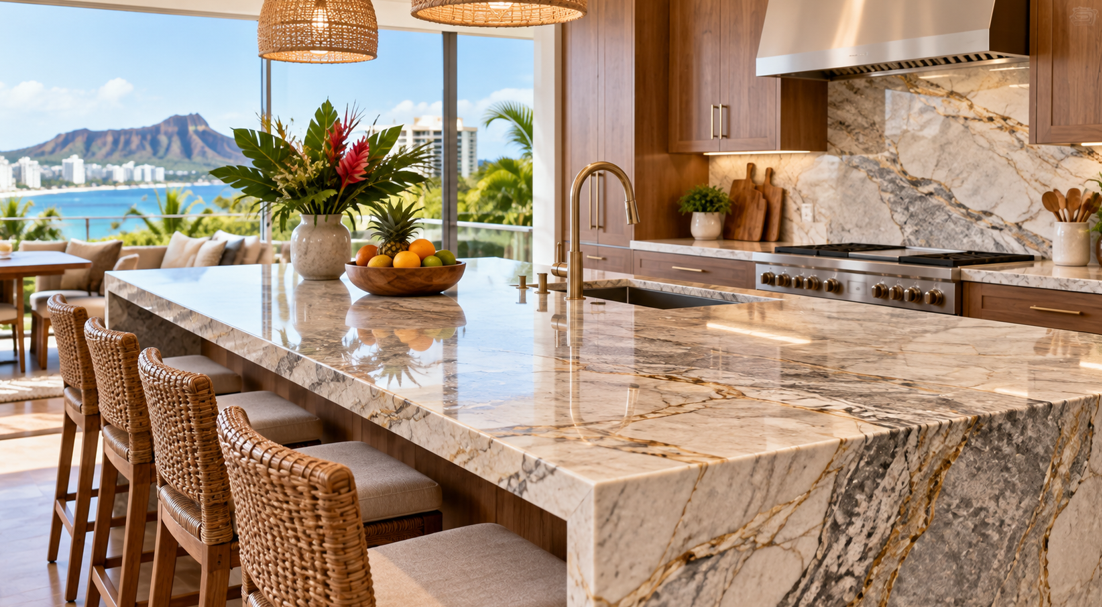
Choosing the right countertop for a Honolulu kitchen can feel like a balancing act. Homeowners want a surface that looks refined, handles daily use, suits Hawaii’s warm and coastal design style, and still makes sense for the realities of island renovation.
Granite is known for durability. Marble is prized for its elegant movement and natural veining. Engineered quartz appeals to homeowners who prefer a more consistent, contemporary appearance. Quartzite sits in an interesting place between these popular choices.
Quartzite is a natural stone formed when quartz-rich sandstone is transformed by heat and pressure. The result is a hard, visually distinctive material that can offer dramatic veining, soft neutral tones, and the one-of-a-kind character many homeowners want from natural stone. For some kitchens, it can deliver the refined appearance associated with marble while offering a surface suited to serious everyday use.
For Honolulu homeowners comparing natural and engineered surfaces, Selective Stone offers access to countertop options and practical guidance shaped by decades of experience in Hawaii’s stone market.
What Makes Quartzite Different?
Quartzite is sometimes confused with quartz because of the similar names, but the two materials are very different.
Quartzite is quarried natural stone. Each slab has its own mineral patterns, veining, colour shifts, and natural characteristics. That means two pieces from the same stone family can still look noticeably different.
Quartz countertops are engineered products made from mineral content combined with resins, pigments, and other materials. Their major advantage is consistency. Homeowners who want a predictable colour or pattern may prefer quartz because one sample is generally more representative of the final installation.
Quartzite offers a different kind of value. Its appeal comes from natural variation.
That can be especially attractive in Honolulu kitchens where homeowners want a surface that feels individual rather than mass-produced. A quartzite slab can become the visual centre of a kitchen island, complement warm wood cabinetry, or bring natural movement into a clean, contemporary space.
Why Quartzite Is Often Called a Middle Ground
Calling quartzite the “middle ground” does not mean it is literally halfway between granite and marble. Each natural stone has its own mineral structure and performance characteristics.
The phrase is useful because quartzite can appeal to homeowners who like qualities found in several different countertop materials.
Marble-Like Visual Appeal
Many homeowners are drawn to marble because of its soft veining and timeless appearance. Certain quartzites offer similarly flowing patterns, pale backgrounds, and elegant movement.
For a Honolulu kitchen designed around white cabinetry, warm wood, brushed metal, or natural textures, a light quartzite can create a sophisticated look without making the room feel overly formal.
It is important, however, not to assume every quartzite looks like marble. Some varieties are much bolder, with stronger colours and dramatic mineral patterns. That diversity is one of the reasons viewing actual slabs is so important.
Durability for Everyday Kitchens
Quartzite is generally valued as a hard natural stone. That makes it attractive for busy households where the kitchen is used throughout the day for food preparation, family meals, entertaining, and everyday living.
No countertop should be treated as indestructible. Using chopping boards, wiping spills promptly, and following care guidance for the selected stone remain sensible habits.
Still, homeowners who love the look of expressive natural stone but want something appropriate for an active kitchen often find quartzite worth considering.
Natural Character With a Modern Feel
Quartzite also works well in modern interiors.
Some slabs feature restrained grey or beige veining that fits beautifully with minimalist cabinetry and open-plan layouts. Others have enough contrast to become a statement surface.
This flexibility can be useful in Honolulu, where homes range from compact condominium kitchens to larger island residences with expansive indoor-outdoor spaces.
Quartzite and Honolulu’s Island Environment
A countertop choice in Hawaii should consider more than colour and pattern.
Honolulu’s climate brings high humidity, strong natural light, coastal air, and year-round warmth. These factors affect how homeowners think about materials throughout the kitchen.
Humidity and Moisture
Kitchens naturally deal with water, steam, and spills, and Hawaii’s humid climate adds another reason to choose durable materials and maintain them correctly.
Quartzite itself is a mineral-based stone, but individual varieties can differ in porosity. Some may benefit from sealing to help reduce absorption and staining.
The important point is that sealing needs should be based on the actual stone rather than a blanket rule. A knowledgeable supplier or fabricator can advise on the specific slab and finish selected.
Areas around sinks, seams, cut-outs, and backsplashes also deserve careful attention. Good fabrication and installation are just as important as the stone itself.
Salt Air and Coastal Homes
Honolulu homeowners living closer to the coast also have to think about salt exposure.
Quartzite does not rust, but a kitchen includes sinks, taps, hardware, appliances, and fasteners that may respond differently to salt-laden air. A successful renovation should therefore consider the countertop as part of a complete material system.
Pairing a durable stone surface with quality fixtures and appropriate installation materials helps create a kitchen that is better suited to island conditions.
Strong Natural Light
Many Honolulu homes are designed to make the most of sunlight and outdoor views.
Natural quartzite can look especially striking in bright spaces because daylight reveals the depth and variation of the stone. Veining that appears subtle under showroom lighting may become more pronounced in a sunny kitchen.
That is another reason to evaluate slabs in person whenever possible and consider how the stone will interact with the lighting in your home.
Popular Quartzite Looks for Honolulu Kitchens
Because quartzite is natural stone, colour and pattern vary widely. That gives homeowners plenty of flexibility.
White and Grey Quartzite
Light quartzite with soft grey veining is popular for homeowners who want an airy, refined kitchen.
It works well with white cabinetry, pale oak, darker wood tones, or black accents. In a smaller Honolulu kitchen, a lighter countertop can also help the room feel visually open.
Warm Beige and Cream Tones
Cream, beige, and warm neutral quartzites can create a softer island-inspired feel.
These colours pair naturally with wood cabinetry, woven textures, sandy tones, and other materials often used in relaxed Hawaii interiors.
For homeowners who want a coastal influence without using an obvious beach theme, warm natural stone can be an effective choice.
Bold, Dramatic Slabs
Some quartzites feature sweeping veins, strong contrast, or rich colours.
These are ideal for homeowners who want the countertop to become the design feature of the room.
A dramatic slab often works best when surrounding materials are more restrained. Simple cabinetry and a quiet backsplash allow the stone to take centre stage without making the kitchen feel overly busy.
Where Quartzite Works Best
Quartzite can be used in several ways depending on the layout of the kitchen.
Kitchen Islands
Large islands are one of the best places to showcase natural stone.
The broader surface gives the veining room to travel across the slab, and the island often becomes a natural gathering point for family and guests.
When using quartzite on a large island, discuss slab size, seam placement, overhangs, sink cut-outs, and vein direction before fabrication begins.
Perimeter Countertops
Quartzite also works well around the perimeter of a kitchen.
A softer pattern can create a continuous natural-stone backdrop without competing with other features in the room.
Some homeowners use the same quartzite on both the island and perimeter counters, while others combine a dramatic island slab with a quieter complementary material.
Full-Height Backsplashes
Using quartzite vertically as a backsplash can create a seamless, high-end look.
A full-height stone backsplash allows the natural pattern to continue up the wall and can reduce the visual interruption created by small-format tile.
This approach requires careful planning because slab dimensions, cut-outs, and pattern alignment can influence the final result.
Homeowners comparing quartzite with granite, marble, engineered stone, and other countertops should think about the entire room rather than choosing a surface from a small sample alone.
Quartzite vs Granite
Granite and quartzite are both natural stones commonly considered for kitchens.
Granite is widely known for practical durability and comes in a huge range of patterns and colours. It can be an excellent option for homeowners who want a proven natural-stone surface and find a slab that fits their style and budget.
Quartzite may appeal more strongly to homeowners who prefer long, flowing veining or a lighter marble-inspired appearance.
The best choice is not about which stone is universally better. It comes down to the specific slab, appearance, maintenance expectations, availability, and project budget.
Quartzite vs Marble
Marble has a distinctive look that many homeowners love, particularly in bathrooms, feature spaces, and elegant interiors.
For kitchens, however, some homeowners prefer to explore harder natural stones that may be better suited to heavy daily use.
Quartzite can be attractive in this situation because certain slabs offer a similarly refined visual quality while having different physical characteristics.
That does not make quartzite “maintenance-free marble”. It remains a natural stone with its own care requirements. The better way to think about it is as an alternative for homeowners who value natural movement and want to compare several stone types before deciding.
Quartzite vs Engineered Quartz
Engineered quartz is often chosen for consistency and convenience.
Its colour and pattern are manufactured, so homeowners can usually predict the final look more easily than with a natural slab.
Quartzite is the opposite in one important sense: variation is part of the product.
If you want unique veining, natural mineral movement, and a surface that does not look identical from one installation to another, quartzite may have the edge.
If predictable colour matching is more important, engineered quartz may be a better fit.
Neither material is automatically right for every kitchen.
How to Choose the Right Quartzite Slab
Natural stone should ideally be selected by viewing the actual slab rather than relying only on a small sample or online photograph.
Look at the Whole Slab
Stand back and study the entire pattern.
Ask where the strongest veining should appear after fabrication. On a large kitchen island, the location and direction of the pattern can significantly affect the finished design.
Expect Natural Variation
Mineral lines, colour changes, and natural fissures are part of the character of stone.
A knowledgeable supplier can explain which features are typical for the material and what to expect after fabrication.
Bring Other Design Samples
If possible, bring cabinet colours, flooring samples, paint references, or hardware finishes when choosing a slab.
A stone that appears cool under showroom lighting may look warmer beside wood cabinetry or in strong afternoon sunlight.
Check Availability Early
This is especially important in Hawaii.
Large stone slabs are heavy and expensive to ship, and island inventory can be more limited than in major mainland markets. Before building an entire kitchen design around a specific material seen online, confirm what is available locally.
Selective Stone’s direct wholesale model helps address one of the practical challenges of island renovation by offering homeowners and contractors access to stocked materials without unnecessary layers of distribution.
Caring for Quartzite Countertops
Good care is usually straightforward.
Clean Spills Promptly
Oils, coffee, wine, sauces, and strongly coloured liquids should be wiped up rather than left sitting on the surface.
Even sealed natural stone benefits from quick cleaning.
Use Suitable Cleaning Products
Use a mild cleaner appropriate for natural stone and follow any care instructions provided for your particular surface.
Avoid assuming that strong chemicals are better. Harsh or highly acidic products may affect stone finishes or treatments.
Use Chopping Boards
Quartzite may be hard, but chopping directly on a countertop is still unnecessary.
A chopping board protects both the finish and your knives.
Use Trivets and Mats
Natural stone generally handles kitchen use well, but trivets are a sensible precaution for very hot cookware.
They also protect the surrounding sealants and finishes that are part of the installed countertop system.
Follow Stone-Specific Sealing Advice
Some quartzite varieties may benefit from penetrating sealer.
Rather than following a fixed schedule, ask whether your actual stone needs sealing and how to check when treatment should be renewed.
Is Quartzite Worth Considering for a Honolulu Remodel?
Quartzite is especially appealing when homeowners want a countertop to provide both visual character and practical performance.
It can suit contemporary kitchens, warm island-inspired interiors, traditional homes, and large statement islands. It can provide subtle neutrals or dramatic movement. And because it is natural stone, each slab brings something individual to the project.
For Honolulu homeowners, its value also comes from the ability to compare it with other natural and engineered surfaces based on local needs rather than generic mainland design advice.
A coastal home may prioritise durable fixtures and materials that work well around salt air. A busy family kitchen may focus on everyday resilience. A condominium renovation may need a light, visually open palette. A larger remodel may centre the entire room around one dramatic slab.
Quartzite can work in all of these situations when the right variety is selected.
The key is to choose the actual material rather than the name alone.
Final Thoughts
Quartzite earns its “middle ground” reputation because it can bring together several qualities homeowners often search for at the same time: the natural movement associated with elegant stone, the hardness expected from a serious kitchen surface, and enough design flexibility to work in both classic and modern interiors.
For Honolulu homes, those qualities can be particularly useful.
Island kitchens deal with humidity, strong sunlight, coastal exposure, and the practical realities of local material availability. A successful countertop choice therefore needs to work beautifully in the room while also making sense for the way the household lives.
Quartzite is not the only answer, and it should not be presented as one.
Granite, marble, engineered quartz, and other surfaces all have their place. The best decision comes from comparing actual materials, understanding maintenance expectations, and choosing a slab that fits your design, budget, and lifestyle.
If quartzite is on your shortlist, contact Selective Stone or visit the Honolulu showroom at 2979 Koapaka Street to compare available stone options and get practical guidance for your kitchen project.
A countertop should be more than a finish. In a Honolulu kitchen, it should become a durable, functional, and beautiful part of everyday island living.